
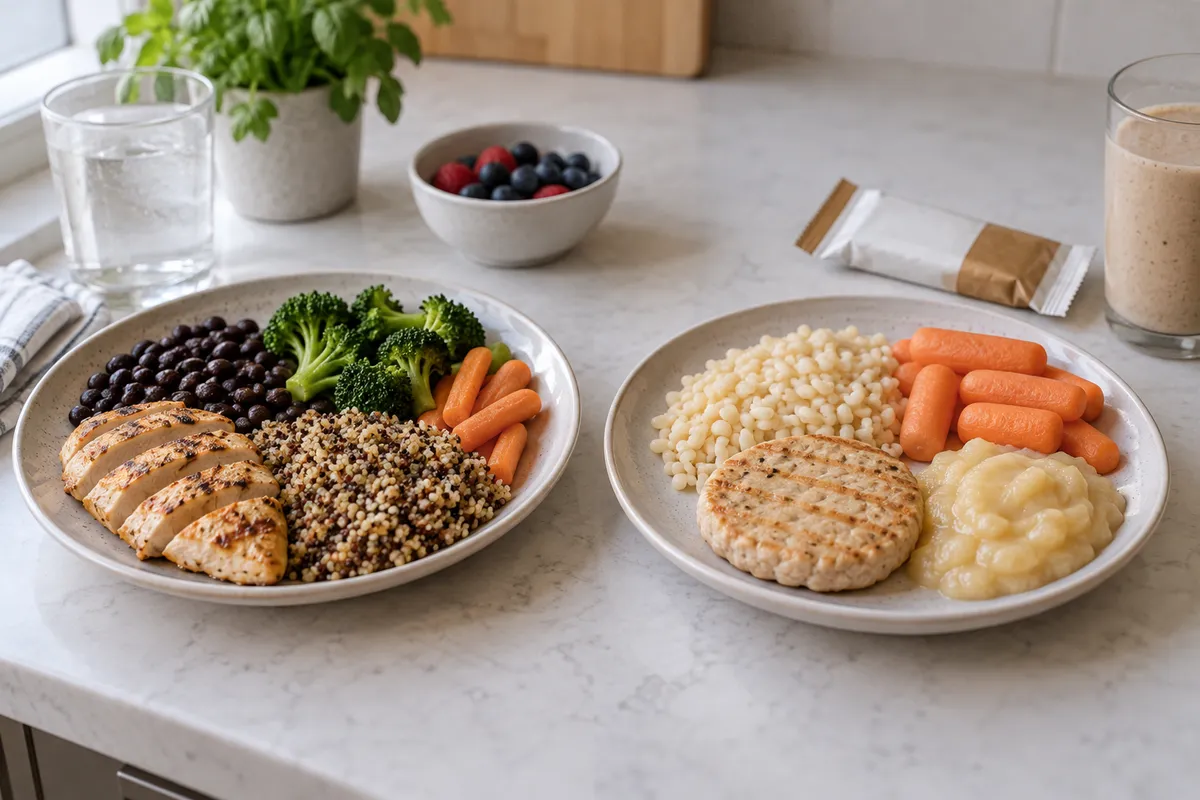
You can read a nutrition label perfectly and still not know how your body will react to the food. A new Virginia Tech study, reported by Medical News Today, suggests that processing itself changes the metabolic response. By the end of this piece, you'll know what that finding means and how to apply it without panicking about every packaged food in your pantry.
What the study found
Per Medical News Today, researchers compared ultra-processed meals with less processed meals that had similar calories and nutrients. The ultra-processed meals triggered a higher insulin response. The findings also suggest that processing changes how the body, including the brain, responds to food, and that nutrition labels may not fully capture this.
The key point is the comparison. The meals were matched on nutrition, so the difference can't be explained by one meal simply having more sugar or fat on paper. Something about the processing appears to matter.
I only have the summary of the study, so I can't tell you details like how many people took part or how large the insulin difference was. Treat this as a meaningful signal, not a final verdict.
Why "same macros" doesn't mean "same effect"
A label lists calories, protein, carbs, fat, and fiber. It tells you what is in the food. It doesn't tell you what the food has been through: how it was broken down, reformulated, or reassembled.
This study points to that gap. Two meals can look nearly identical on paper while your body handles them differently. Insulin is the hormone that helps move sugar from your blood into your cells, so a bigger insulin response is a real physiological difference, not a labeling quirk.
The researchers also point to brain responses, which suggests processing may influence more than blood sugar handling alone.
"High-protein" and "high-fiber" aren't a free pass
Many ultra-processed products are marketed on their numbers: high-protein, high-fiber, calorie-conscious. That's the part of this study worth remembering. Being nutrient-dense on the label doesn't make a food metabolically equivalent to a less processed one.
That doesn't make those products dangerous. It means the claim on the front of the package is a starting point, not proof that the food behaves like its whole-food counterpart.
Practical swaps that don't require a overhaul
The study doesn't tell us which specific products are worst, so I won't invent a ranking. But the logic gives you a simple rule of thumb: when two options are close nutritionally, pick the one that looks more like something you could make in a kitchen. Some examples of the idea:
- Protein: a plain piece of chicken, eggs, or canned fish instead of a reformulated protein bar or shake.
- Fiber: oats you cook yourself, beans, or whole fruit instead of a fiber-fortified snack.
- Breakfast: plain yogurt with fruit instead of a flavored, high-protein, low-calorie yogurt dessert.
These are my illustrations of the principle, not tested findings from the study. Start with the one or two packaged foods you eat most often. Swapping those does more than agonizing over rare ones.
How to read labels with this in mind
Labels still matter. They're useful for calories, added sugar, and sodium. Just add one more step: check the ingredient list. A short list of recognizable foods usually signals less processing. A long list of unfamiliar additives, or a front-of-package nutrition boast, is a cue to look closer.
Keep it in proportion
Nothing in this research says every packaged food is harmful. Convenience matters, budgets matter, and a less processed option isn't always available. The study adds nuance to a heated debate: food quality is more than a macro tally.
The action to take: next time you shop, pick one regular packaged item, compare it with a less processed alternative, and make the swap if it fits your life.