By the end of this article, you'll understand one of physics' more unsettling worries, that the universe could abruptly change its own rules, and why a new study suggests it probably won't.
Per a report from Phys, researchers have proposed that quantum interactions in the early universe may have "locked" fundamental fields into their current energy states. That would stop them from tunneling into lower-energy configurations. The work, which involves a researcher in a College of Engineering and Computer Science, borrows ideas from quantum information science, the field behind quantum computing, to explain why the universe appears so stable.
The worry: a universe stuck in a "false vacuum"
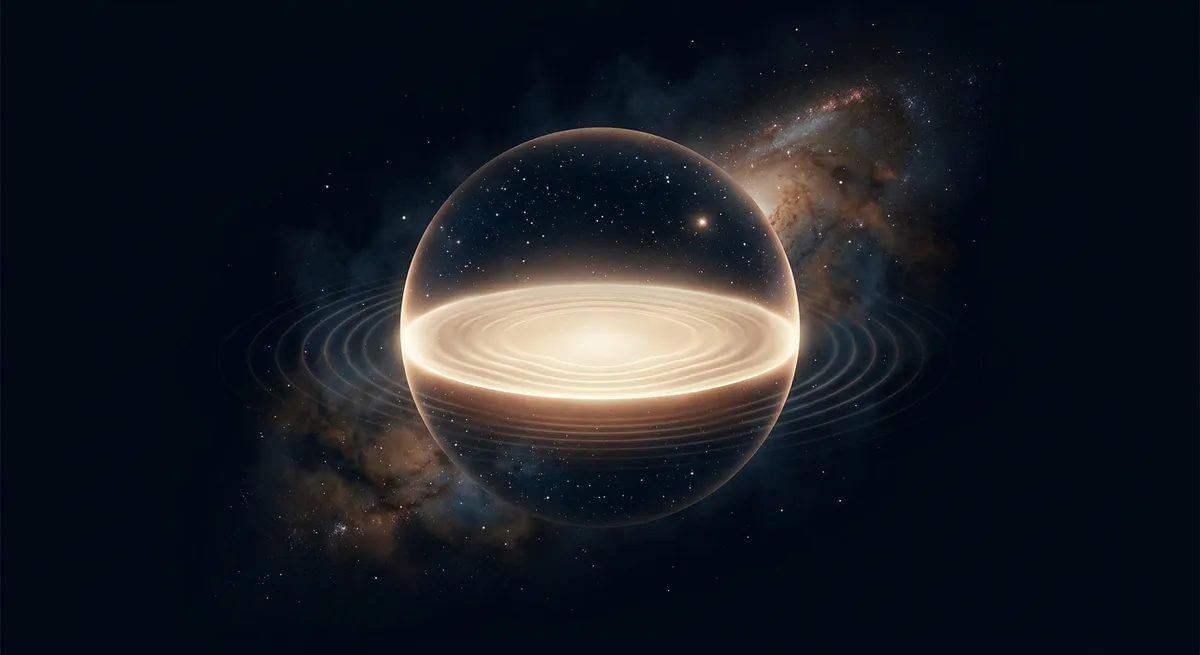
Physicists have long been concerned that some cosmic fields, the Higgs field being the standard example, might not sit in their lowest possible energy state. If a field is in what's called a false vacuum, it is stable-looking but not truly at rock bottom. In theory, it could spontaneously shift to a lower-energy configuration and fundamentally alter reality.
Think of a ball resting in a small dip on a hillside. It looks settled. But if there's a deeper valley further down, the ball could, in principle, end up there. In quantum physics, it doesn't even need to climb over the hill. It can "tunnel" through.
That's the existential concern the study addresses: if the universe's fields could tunnel, why hasn't it already happened?
The proposed answer: the early universe froze things in place
The new study suggests that quantum interactions in the early universe effectively locked these fields into the states they occupy now. Instead of the universe merely being lucky, the argument goes, something about its early history kept the fields from tunneling into lower-energy states.
This is a proposal, not a settled fact. But it reframes the question. Rather than asking why the universe has survived so long, it asks what mechanism might have made the current state sticky from the start.
Where quantum computing comes in
The study applies principles from quantum information science. Two ideas from that world are central to the angles researchers and commentators have drawn out of this work.
Decoherence
Quantum computers are famously fragile. Their quantum states get disrupted when they interact with their surroundings, a process called decoherence. Engineers spend enormous effort fighting it. In the cosmic context, the same kind of environmental interaction may be a feature rather than a bug: it could keep a field from smoothly exploring other states and tunneling away.
The quantum Zeno effect
A related idea is the quantum Zeno effect, in which repeated observation or interaction can freeze a quantum system in place. A watched quantum pot, in a sense, never boils. If interactions in the early universe worked similarly, they could have pinned the fields where they are.
I'd stress that the source describes these as concepts relevant to the research; I can't tell you from the available reporting exactly how the authors build their model, so treat the analogies as intuition, not the full mechanism.
Why this matters beyond the thought experiment
It's easy to shrug at a risk measured in cosmic timescales. But there are two reasons this kind of work matters.
- It speaks to the universe's long-term stability. If fields are effectively locked, the ultimate fate of the universe looks less like a sudden spontaneous change and more like a stable long haul.
- It links two fields. Tools built to understand and control quantum computers are being used to probe questions about the cosmos. Phys frames this as the intersection of quantum information science and cosmology, at a time when the former is advancing quickly.
What you can take from this
Three points to carry away:
- A "false vacuum" is a state that looks stable but could, in theory, decay into a lower-energy one.
- This study proposes that early-universe quantum interactions locked fields into their current states, blocking that tunneling.
- The reasoning draws on quantum computing concepts like decoherence and the Zeno effect, which show how interaction with an environment can hold quantum systems in place.
The next time someone tells you the universe is fragile, you can answer that it may be held in place by the same quantum physics that makes it so strange. And if you want to follow the idea further, read the original Phys coverage and look for the underlying paper to see how the authors make their case.