Spreading crushed rock on a farm field sounds more like gardening than climate tech. But researchers at UC Davis are testing exactly that, and by the end of this article you'll understand how the method works, why it could matter, and which big questions scientists still have to answer. The work was reported by Phys.
What enhanced rock weathering actually is
Rocks have been absorbing carbon dioxide from the air for a very long time. It happens naturally as rain and air slowly break down minerals. Enhanced rock weathering takes that slow geological process and tries to speed it up.
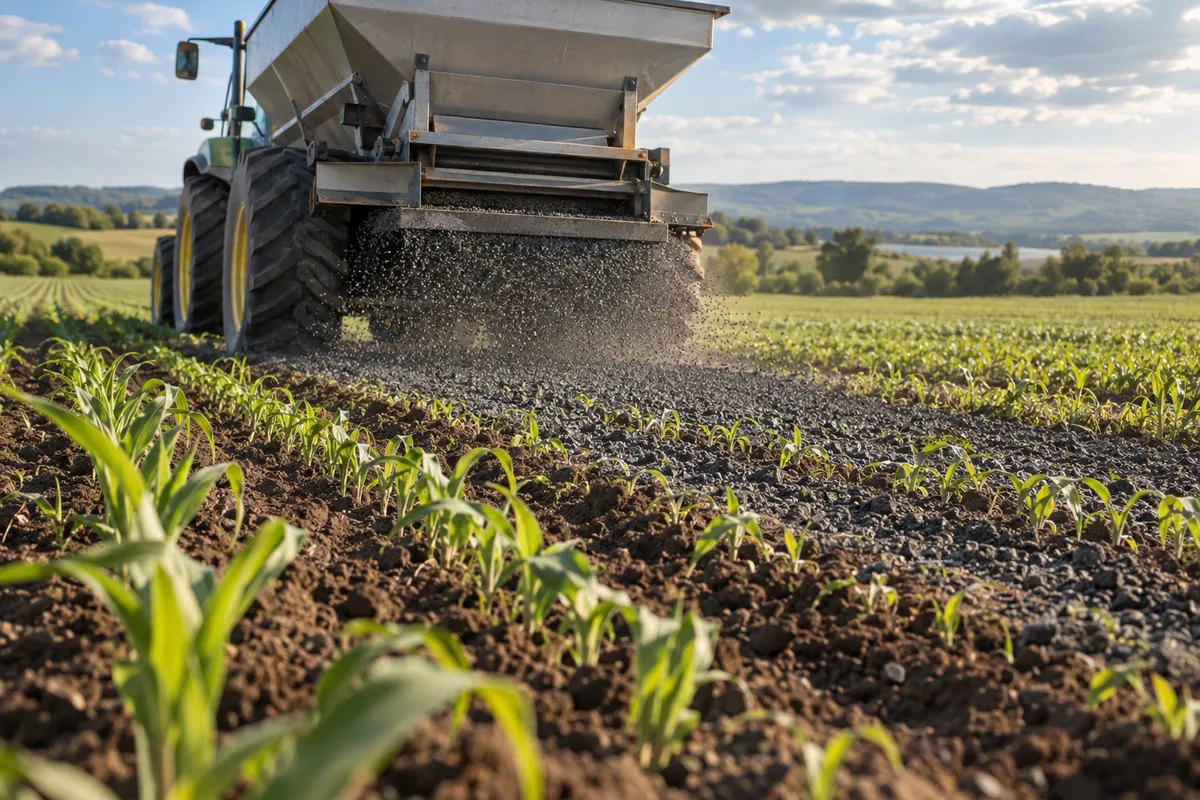
The approach, per Phys's coverage of the UC Davis research, involves spreading crushed basalt on agricultural land. Grinding the rock into smaller pieces exposes more surface area, which gives the chemistry more room to work.
How rock turns CO₂ into something stable
The core idea is chemical. As the rock weathers, CO₂ is converted into bicarbonate, a form of carbon that can be carried away and stored rather than floating back into the atmosphere. That's the carbon-removal part: the gas leaves the air and ends up locked in a different form.
You don't need to memorize the chemistry. The takeaway is that this is a natural reaction being given a push, not a brand-new invention.
Why farmland is the target
Farms already have equipment and routines for spreading materials on fields. That's a big reason enhanced rock weathering is getting attention: it could potentially scale across large areas of agricultural land.
There's a possible second benefit. According to the report, the method may also improve soil nutrients and crop health. If that holds up, farmers could gain something from the process too, not just the climate.
Note the word "potentially." That payoff still needs to be demonstrated in real fields.
Why carbon removal is in the spotlight
Atmospheric CO₂ levels are far above preindustrial levels. Clean energy can cut new emissions, but it can't pull out the "legacy" CO₂ already in the air. That's the gap carbon-removal methods aim to fill.
Per the report, major companies including Microsoft and Google are investing heavily in carbon removal. Enhanced rock weathering fits that interest because of its possible scale.
What scientists still don't know
This is where realism matters. The UC Davis researchers are testing the method because more field science is needed to prove where and how it works best. The open questions, as the coverage frames them, include:
- Measurement: How do you confirm how much CO₂ a field of crushed rock actually removed?
- Scale: Can the approach work across many farms, not just test plots?
- Soil conditions: Does it work equally well in every soil, or do some conditions help or hurt?
It's reasonable to read those gaps as a sign the field is early. A method can look elegant on paper and behave differently on a real farm, which is exactly why field trials exist.
How to think about it as a reader
Enhanced rock weathering is a promising idea with a solid natural basis, but not a proven fix. A few ways to keep your footing when you see headlines about it:
- Look for field data. Claims backed by measured results in real soils carry more weight than projections.
- Watch how carbon is counted. Since measurement is an open question, careful accounting matters.
- Treat it as one tool. Carbon removal addresses legacy CO₂; it doesn't replace cutting new emissions with clean energy.
The takeaway
When you hear a carbon-removal claim, ask one question: how was it measured in the field? Enhanced rock weathering may turn farms into carbon sinks, but the trials now underway will decide whether that's a real tool or just a good story.